
Build a Mecklenburg County Search
A useful Mecklenburg County people search follows the fact already known. A full name points toward the Assessor owner roll, the Register of Deeds party index, NC eCourts, voter records, business registrations, and license boards. An address works best in the Assessor search or POLARIS. An older address may need a city directory before it can be tied to a modern parcel. For a deceased person, estates, deeds, wills, death records, and newspapers tend to form a better chain than current directories.
Use official records to confirm each step. A tax mailing address may reveal where a notice goes, but it does not prove where an owner lives. A deed role shows a link to an instrument, not a current address. A court result identifies a case party, not the outcome of every claim. These limits matter when common names produce several Mecklenburg County search results.
- Start with the Assessor when a name or street address may connect to land.
- Carry the owner name and deed reference into the recorded-instrument index.
- Check eCourts by party name, then use the clerk when an older image is missing.
- For family history, add estate files, vital records, directories, and newspapers.
- Ask the actual custodian for a record that has no public web copy.
Note: Save exact parcel, instrument, and case numbers as the trail develops; those keys separate people who share a name.
Mecklenburg County Search Offices
North Carolina divides the Mecklenburg County records search among distinct custodians. The Register of Deeds records land instruments, plats, assumed names, marriages, and several vital services. The Clerk of Superior Court keeps civil, criminal, estate, and special-proceeding files. The Office of Tax Administration and Land Records maintain the owner roll, situs address, tax mailing address, legal description, and assessed values. Charlotte is the county seat, but these county systems also cover Cornelius, Davidson, Huntersville, Matthews, Mint Hill, Pineville, and unincorporated areas.
Mecklenburg County Register of Deeds
720 East Fourth Street, Suite 103
Charlotte, NC 28202
Clerk of Superior Court
832 East Fourth Street
Charlotte, NC 28202
Public hours: weekdays, 9 a.m. to 5 p.m.
County Vital Records
618 North College Street
Charlotte, NC 28202
Local birth and death service
A portal is not always the custodian. The county request hub routes court, deed, tax, GIS, sheriff, election, city, and school requests to the office that owns the file. Detailed access rules belong with the Mecklenburg County public records system, while the search path here stays focused on finding a person.
Search Mecklenburg County Deed Names
The Aumentum Recorder Web Access index accepts a party name, date range, book and page, instrument number, and optional instrument type. A partial beginning of a name broadens the match. Party roles are important: a grantor transfers an interest, while a grantee receives one. Use the current deed reference to identify the prior owner, then search that grantor and repeat the process backward.
Open the official Mecklenburg County deed index before reviewing the interface shown here.
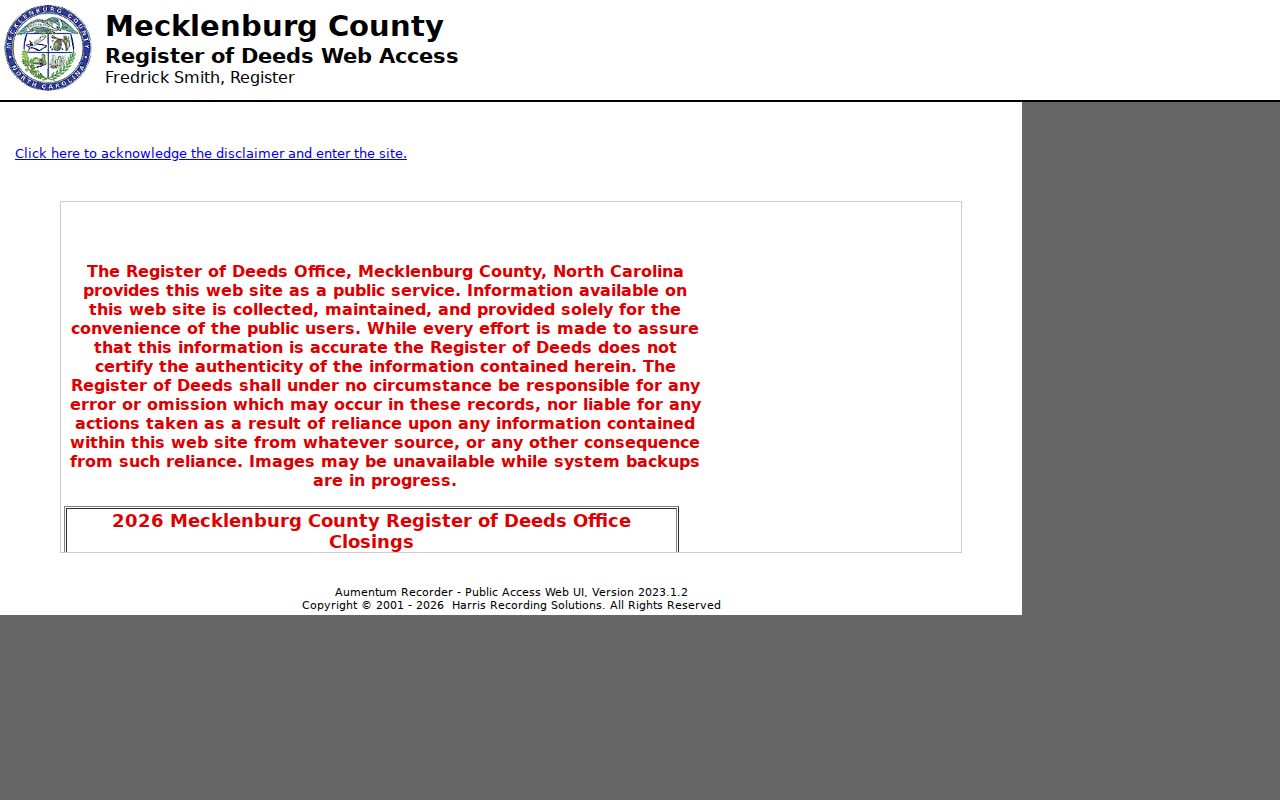
The acknowledgement warns that web data are convenience copies, images may be unavailable during backups, and an office-certified copy is the authoritative version.
| Search control | Best use | Required |
|---|---|---|
| Party Name | Individual or business, including a partial beginning | Usually |
| Instrument Type | Narrow to a deed, lien, plat, or other class | No |
| Date Range | Limit a likely recording period | No |
| Book / Page | Retrieve a known citation | No |
| Instrument Number | Retrieve a known recording number | No |
Insider tip: For a thorough pre-1990 assumed-name search, the Register of Deeds recommends leaving document type blank and trying initials with and without spaces, spelling variants, and leading articles. Assumed-name coverage is verified from 1913 to the present. Other deed-series dates vary, so do not assign one start year to the whole portal.
Mecklenburg County Property Search Trail
The Assessor search can take all or part of an owner name, address, or eight-digit parcel ID. Selecting Owner reduces stray address matches for a common surname. Results may appear as a list or map, with filters for value, land use, lot size, neighborhood, sale date, sale price, and year built. A parcel card then links ownership, mailing address, legal description, sales, deed references, buildings, tax bills, and maps.
Compare the Mecklenburg County Assessor search controls with the captured official screen.
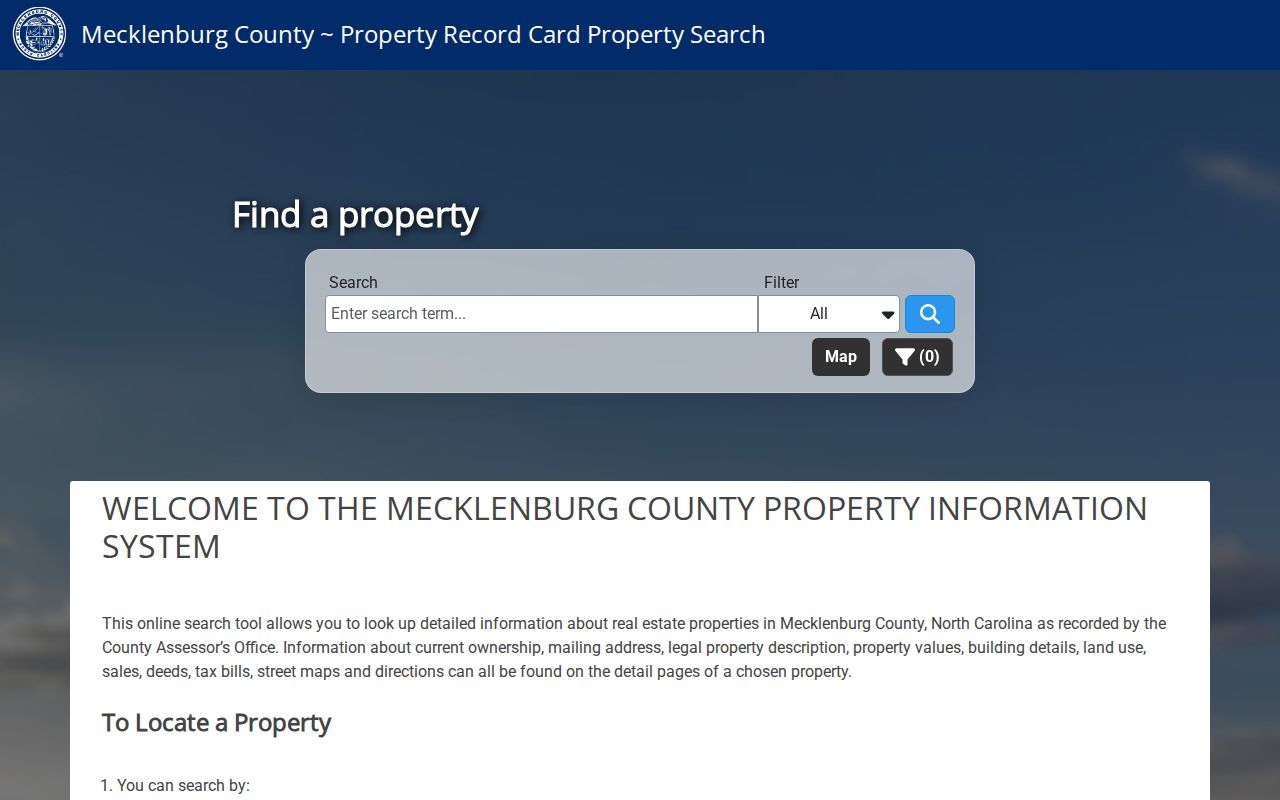
This official owner roll is free and can export results, but a just-recorded deed may appear before the assessment database catches up.
Read Mecklenburg County Address Records
Mecklenburg County land files distinguish the situs address, where the parcel sits, from the mailing address used for tax notices. The legal description identifies the land in recorded terms. The local parcel ID is an assessment and GIS key, not the legal description. That distinction keeps a Mecklenburg County people lookup from treating a tax destination as proof of residence.
POLARIS accepts an address, parcel number, owner, or landmark after at least three characters. Its layers include zoning, floodplain, buffers, and historic districts. GeoPortal adds schools, voting districts, representatives, services, parks, and libraries. These maps describe the parcel and jurisdiction. Recorded deeds establish title.
View the official POLARIS ownership map alongside its captured search screen.
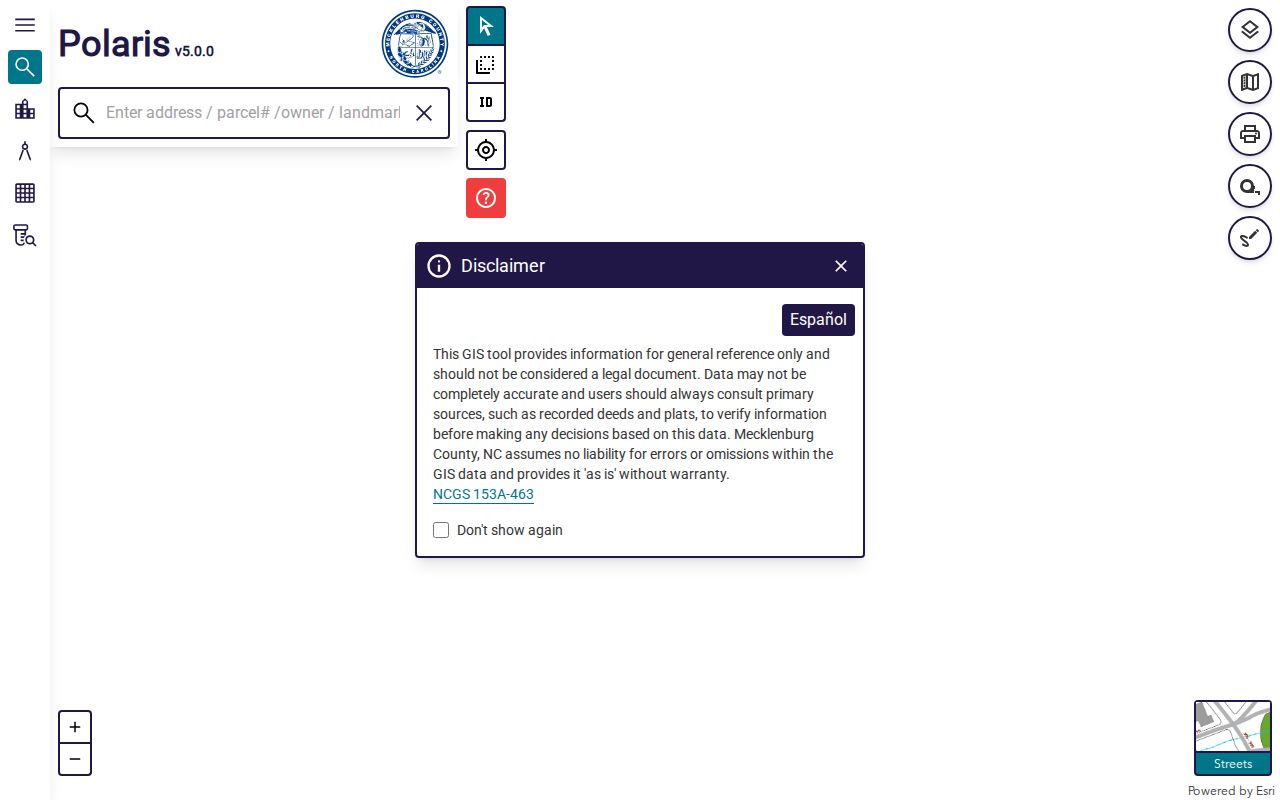
POLARIS can bridge an old location to a current parcel, especially when a landmark or approximate block is known.
Postal city, municipality, ZIP, and extra-territorial jurisdiction can differ. Davidson and Mint Hill cross county lines, while an unincorporated parcel may still carry a Charlotte mailing name. “Uptown” is informal geography, so official searches need a street address.
Run a Mecklenburg County Court Search
Mecklenburg County Superior and District Court files are part of North Carolina Judicial District 26. NC eCourts Smart Search accepts a name or record number, with optional filters for party name, case number, citation number, and county. A public docket may show the case number, caption, party roles, attorneys, filings, events, dates, charges, financial entries, and public documents.
Open the statewide NC eCourts Portal before using the captured party-search screen.
Select Mecklenburg as the location when a common name returns cases from across North Carolina. A docket entry should be read in context, since a filing or charge does not by itself establish a final result.
| Court record | Online route | Offline route |
|---|---|---|
| District and Superior Court | NC eCourts party and case search | Courthouse terminal or clerk division |
| Estates and special proceedings | Portal when migrated and public | Estates division email or courthouse file |
| Federal Western District cases | PACER account and usage fees | Federal clerk in Charlotte |
When Mecklenburg Court Search Stops
Mecklenburg County entered eCourts on October 9, 2023. A case may be indexed while an older document remains outside the remote portal. Courthouse terminals still provide public searches for criminal defendants, case numbers, victims or witnesses, civil cases, estates, and special proceedings. Sealed, expunged, juvenile, adoption, and commitment matters are not general public files.
Insider tip: Send a missing pre-cutover document request to the matching clerk division. The county publishes separate email queues for criminal, civil, and estates or special proceedings. Include the record type, party names, and file number if known. This route is more precise than sending a broad request to a portal operator.
North Carolina court inspection is free. Ordinary copies are 25 cents per page. A certified one-county criminal name search uses the state form and costs $25, while federal PACER uses its own account and fee rules.
Note: No online result is conclusive for an older Mecklenburg County file; check the courthouse terminal or the proper clerk division.
Find Mecklenburg County Vital Records
Mecklenburg County Vital Records handles local births and deaths from 1913 forward by mail, online order, or in-person request. It can also issue statewide North Carolina births and deaths from 1971 forward at the local counter. The Register of Deeds provides Mecklenburg marriage records. Divorce decrees and case papers remain with the Clerk of Superior Court, while the state vital office maintains event certificates.
Certified copies are not open to every requester. Under G.S. §130A-93, access generally turns on the record subject, listed family relationship, legal rights, or authorized representation. Applications ask for the recorded name, event date and place, parent details where relevant, requester contact and relationship, identification, signature, and payment. County birth and death certificates cost $10. A local certified marriage copy also costs $10.
- Certified copy
- An official copy authenticated by the custodian for legal use.
- Index
- A finding record that points to an event or instrument but is not the source document.
- Decedent
- The person who died and whose estate or death record is being searched.
- Docket
- The court’s running list of filings and events in a case.
Historical research follows a different path. G.S. §132-11 ends many state-law confidentiality limits after 100 years, but explicit exceptions remain. An archive index does not make every modern certificate public. Search the State Archives, Carolina Room, and older registers, then request the exact source under its own access rule.
Mecklenburg County Voter Lookup
The NC State Board of Elections search requires first name, last name, and a choice between registered or removed and denied status. Middle initial, birth year, and county are optional. Selecting Mecklenburg narrows common names. A public result can show registration status, precinct, districts, polling place, sample ballot availability, absentee information, and election participation history. It never shows how a person voted.
North Carolina withholds a voter’s full birth date, Social Security number, driver license number, registration-agency identity, email, and identification images. A signature may be inspected but not copied or traced. Qualifying protected voters can have the actual address withheld. The full mechanics and weekly file are covered in the Mecklenburg County voter registration lookup.
Note: Participation history marks an election in which someone took part; it never discloses a candidate or ballot choice.
Mecklenburg County Offender Records
Use the Mecklenburg County Sheriff inquiry for current local detention information. The state Department of Adult Correction covers prison, probation, and parole records, with published history reaching 1972. Federal Bureau of Prisons records generally begin in 1982. These are separate systems, and charges or custody status must not be described as convictions.
Review North Carolina’s official offender search choices in the captured state resource screen.
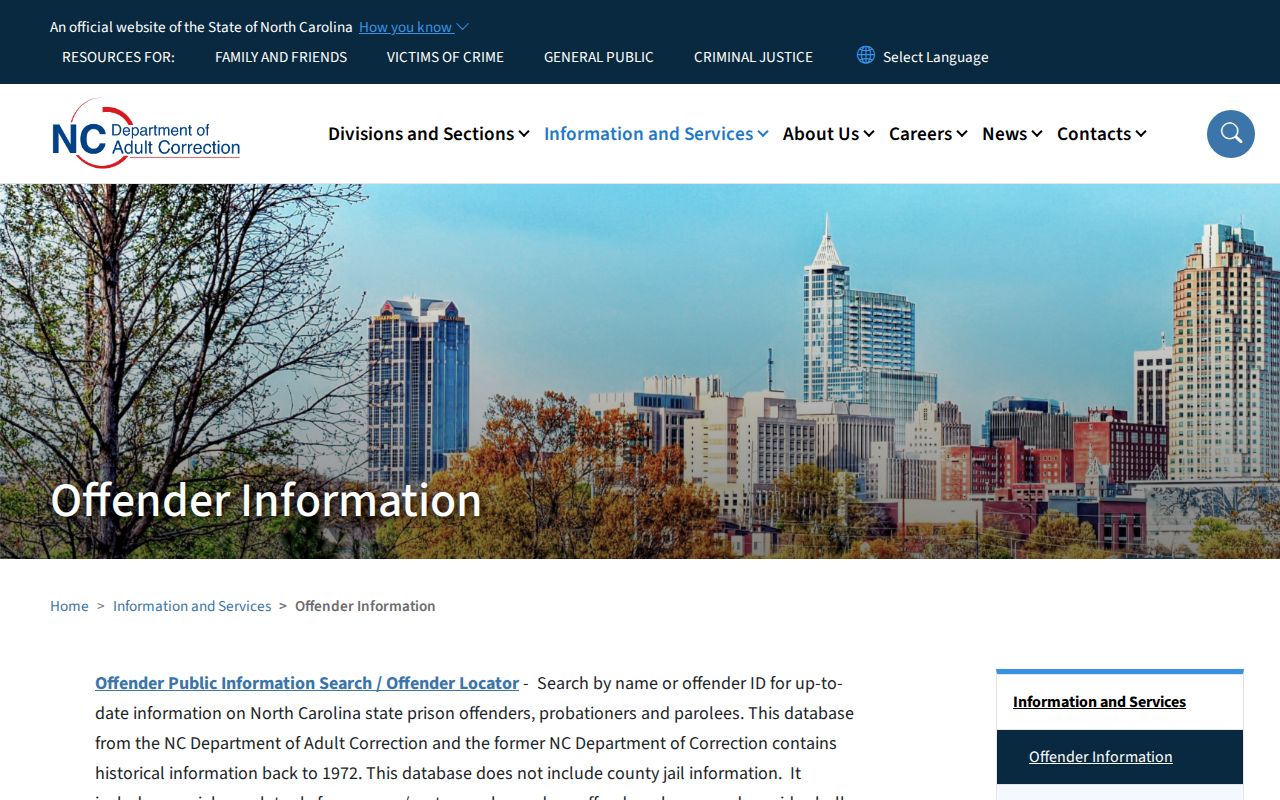
The state screen routes among offender information, registry tools, and notification services; each has its own scope and safety warnings.
When Sheriff web data do not supply an older arrest or warrant record, use the Public Information form. It asks for the record, date range, requester contact, intended use, and needed date. The Sheriff advises allowing three to five business days for approval. Current detention, state correction, federal custody, and court outcomes should be checked separately.
Mecklenburg County Business Directory Trail
A business name can connect a person to several official files. The North Carolina Secretary of State entity search supports company or individual mode and can return status, registered agent, addresses, officials, and filed documents. Statewide assumed-name filings began under Article 14A on December 1, 2017. Earlier Mecklenburg assumed names remain in the county Register of Deeds index. Professional credentials must be checked with the relevant licensing board because North Carolina has no single generic licensee database.
Community directories can add a public phone or website, but membership is not an official ownership finding. See the Charlotte Area Chamber member search represented in the captured interface.
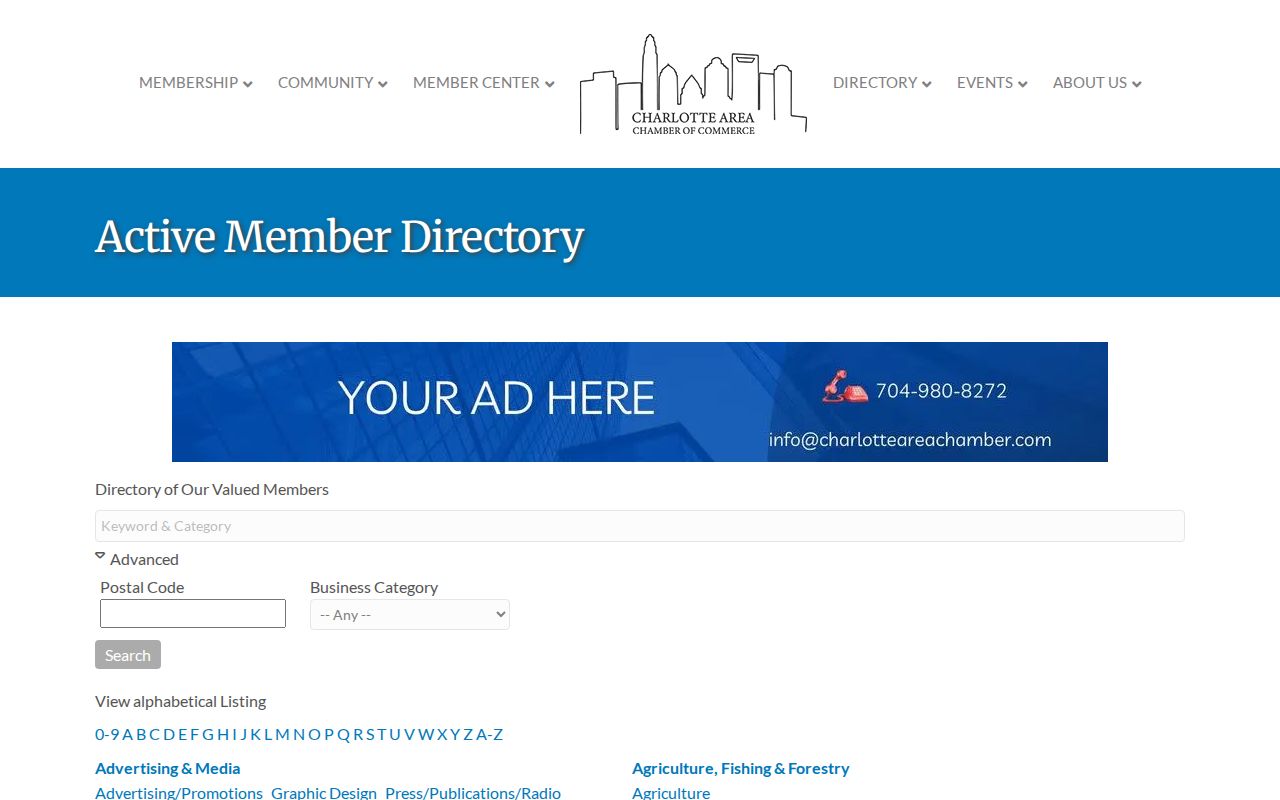
The chamber tool accepts keyword, category, ZIP, and alphabet browsing. Confirm a principal or registered agent in the Secretary of State record rather than relying on a member card alone.
| Source | What it can show | Authority |
|---|---|---|
| Secretary of State | Entity status, agent, officials, filings | Official state record |
| Assumed-name index | Business name, person, county, dates | Official filing index |
| Licensing board | License number, status, public discipline | Board-specific official record |
| Member directory | Public business contact and category | Voluntary association listing |
Trace Mecklenburg County Heirs
Estate files can link a decedent to an executor, heirs, creditors, and real property. Begin with the Clerk of Superior Court estate or special-proceeding file. Follow any will, inventory, or land reference to a Register of Deeds estate instrument, then compare the parcel’s tax mailing address. When no will exists, search the separate administration file because an intestate estate is not stored as a will.
Older Mecklenburg County people records reach beyond the current courthouse system. The State Archives describes county deed volumes 1 through 19 for 1762 to 1826, estates from 1735 to 1902, and wills from 1749 to 1869. Wills before 1760 were filed under the Secretary of State system; later originals came under county jurisdiction. Those shifts explain why one surname search cannot cover every era.
Note: Search an estate administration even when no will appears; intestate files can still identify heirs and land.
Mecklenburg County Historical Directory Search
The Robinson-Spangler Carolina Room is the main local fallback for city directories, school yearbooks, family histories, maps, newspapers, photographs, manuscripts, and government records. Onsite research is by appointment. Telephone and virtual reference run weekdays from 9 a.m. to 5 p.m.; staff may email limited copies. The Vault is free from anywhere, while some newspaper and genealogy databases require a library card or a library-network computer.
Check the Carolina Room’s archives and special collections before planning an onsite Mecklenburg County search. Verified Charlotte directory editions include 1875-76, 1896-97, 1933, 1935, 1937, 1943, and 1956. The 1935 Hill volume has alphabetical residents, a numerical phone directory, and a street-by-house-number section that works as a reverse address lookup.
School directories cover 1934 through 1981 and may list a teacher, subject, home address, and phone. Newspaper runs include the Charlotte News, Charlotte Observer, Charlotte Democrat, and several community publications, though some runs are incomplete. Directory data often reflect an earlier canvass, so an omission is not proof that a person was absent.
Note: Ask the Carolina Room about an exact year before visiting because the published directory list does not prove a continuous run.
Mecklenburg Records Survived Without Fire
A broad Mecklenburg County courthouse-fire loss is often easy to assume, but no authoritative loss note was found in the State Library formation table. The stronger explanation for scattered early custody is administrative. An 1875 recollection says early sheriffs, clerks, and Registers of Deeds kept offices at their country homes until legislation required courthouse offices.
Myth check: Do not label a missing Mecklenburg County people record as “lost in the courthouse fire.” Courts first met in homes and taverns, then moved through courthouses at Trade and Tryon, Trade and Church, South Tryon, East Trade, and finally the consolidated courthouse dedicated on East Fourth Street in 2007. Series dates, office changes, and archival custody are better leads.
Mecklenburg government dates its formation from western Anson County to 1762 and its first official action to February 1763. Search both date conventions in catalogs. Early deeds, estates, wills, marriage bonds, and registers also span different custodians and start years.
Protect Mecklenburg County Search Data
Public access has firm limits. North Carolina protects full Social Security, taxpayer, driver-license, passport, bank, card, PIN, and password data in public filings. An affected person may ask the Register of Deeds or clerk to redact listed identifiers from an online image without charge, but the request must identify the information, document, and exact location. The Address Confidentiality Program offers a substitute address and mail forwarding to qualifying survivors through trained enrollment assistants.
Commercial compilations can merge people with similar names or keep stale details. An official index is better for source checking, but even an index may lag a new deed, omit a protected field, or lack an older image. Compare source date, role, and custodian before treating two Mecklenburg County records as the same person.
Keep copies of source citations, not just screenshots of search results. If an online record appears wrong, contact the office that owns the source. The portal may display the data, but only the custodian can explain a redaction, correct an official field, provide a certified copy, or direct a lawful request for material that is not online.