
Run a Mecklenburg Voter Lookup
The North Carolina State Board of Elections Voter Search is the direct online route for one Mecklenburg County voter. Enter the registered first and last names, select the registered status box, and use the optional birth year to narrow a common name. Choosing Mecklenburg in the county list prevents matches from the other 99 counties from crowding the result. The tool is free, needs no account, and also lets a searcher include removed or denied registrations.
| Search control | Input | Required? | How to use it |
|---|---|---|---|
| First Name | Text | Yes | Use the registered first name |
| Middle Initial | Text | No | Enter one initial when known |
| Last Name | Text | Yes | Use the registered surname |
| Year of Birth | Dropdown | No | Choose a year, not a full birth date |
| County | Dropdown | No | Select Mecklenburg for local matches |
| Voter Status | Checkboxes | Yes | Registered, or Removed or Denied |
| Search / Reset | Buttons | Not applicable | Run the query or clear every field |
The official interface is shown in the NCSBE voter-search source.
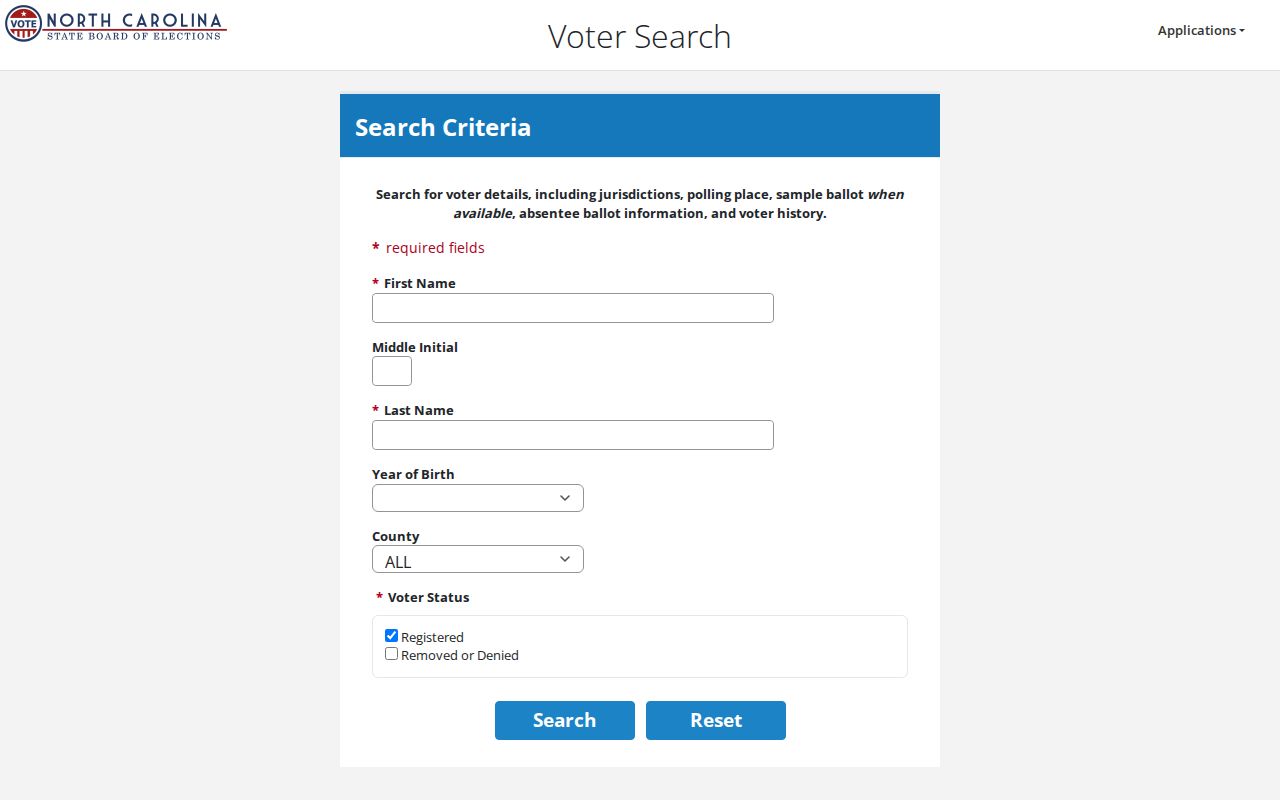
The screen makes the key distinction clear: names and a status choice start the search, while county and birth year help reduce false matches.
Read Mecklenburg Voter Record Results
A matching result links to more than a simple name. It can identify the voter’s status, county registration information, jurisdictions, assigned polling place, and any available sample ballot or absentee information. Participation history lists elections in which the person participated. It never reveals how the person marked a ballot. That line matters when using voter records for family research, civic work, or checking one’s own election assignment.
| Identity | Name, suffix, county registration number and NCID |
|---|---|
| Registration | Status, status reason, registration date and category |
| Contact geography | Residence and mailing address, subject to protection rules |
| Voter profile | Party, race, ethnicity, gender, birth year and age fields |
| Election districts | Precinct plus congressional, legislative, judicial, county, municipal and service districts |
| History | Election participation only, with no ballot selections |
Some bulk fields use a number sign or a masked date such as xx/xx/xxxx to flag review or conceal a value. Verification columns report yes-or-no checks for identification data, not the underlying driver license or Social Security number.
Note: A residence address is a registration field, not proof that the voter still lives at that address today.
North Carolina Voter Privacy Lines
G.S. §163-82.10 draws a precise public and confidential split. Public voter registration data includes the name, county voter ID, residence and mailing address, sex, race, age rather than full date of birth, party, precinct and districts, registration date and participation. A signature may be viewed, but it may not be copied or traced. The weekly file does not carry the signature.
Confidential by North Carolina law. Social Security numbers, full dates of birth, registration-agency identity, email addresses, driver license numbers, and voter-ID photos or copies are withheld. A qualifying protected voter’s actual address is also concealed.
Public access is not leave to stalk, threaten, impersonate, or evade a protective order. North Carolina’s stalking law, G.S. §14-277.3A, covers repeated harassment or monitoring without a legal purpose when the conduct creates a reasonable fear for safety or substantial emotional distress. Use Mecklenburg County voter rolls only for lawful research and civic purposes.
Mecklenburg Voter Status Is Nuanced
An inactive label does not mean a voter registration has been canceled. Under G.S. §163-82.14, the county starts a confirmation process after two federal election cycles without contact. If a forwardable notice gets no response within 30 days, or returns as undeliverable, the record may become inactive. The voter remains registered and may vote after verifying or updating the address.
Myth: inactive means removed. Removal comes only after two more federal general election cycles without a vote or other voter contact. The stages are not synonyms.
List maintenance can also draw on a voter’s written move notice, registration-agency data, information from another jurisdiction, death records, felony-sentence data, duplicates, voter requests, and sustained challenges. The process must be nondiscriminatory and follow federal voting-rights rules. Current downloads omit removed entries when the most recent last-voted date is more than ten years old, so an old registration can vanish from the present file while older snapshots still preserve context.
Get North Carolina Voter Files
The NCSBE voter registration data page publishes free statewide and county ZIP downloads. Files are refreshed on Sunday evenings and arrive as tab-delimited text, which opens in spreadsheet or database software after extraction. Ordinary bulk access has no paid request form, account, or eligibility test. Mecklenburg County appears as its own county download, while the statewide file supports cross-county work.
- Open the official data landing page and select the current Mecklenburg County file. Use the landing page instead of saving a direct file name because download names may change.
- Download and extract the ZIP. Read the linked layout before assigning column names or interpreting status, district, masking, and verification codes.
- Use the current file for registration fields. Download the separate voter-history data and join it by NCID when participation is needed.
- Return to the county Board of Elections for a custom county or precinct electronic list. Under §163-82.10(c), the office may recover its actual preparation cost.
The weekly data choices and supporting files appear in the official voter-file download source.
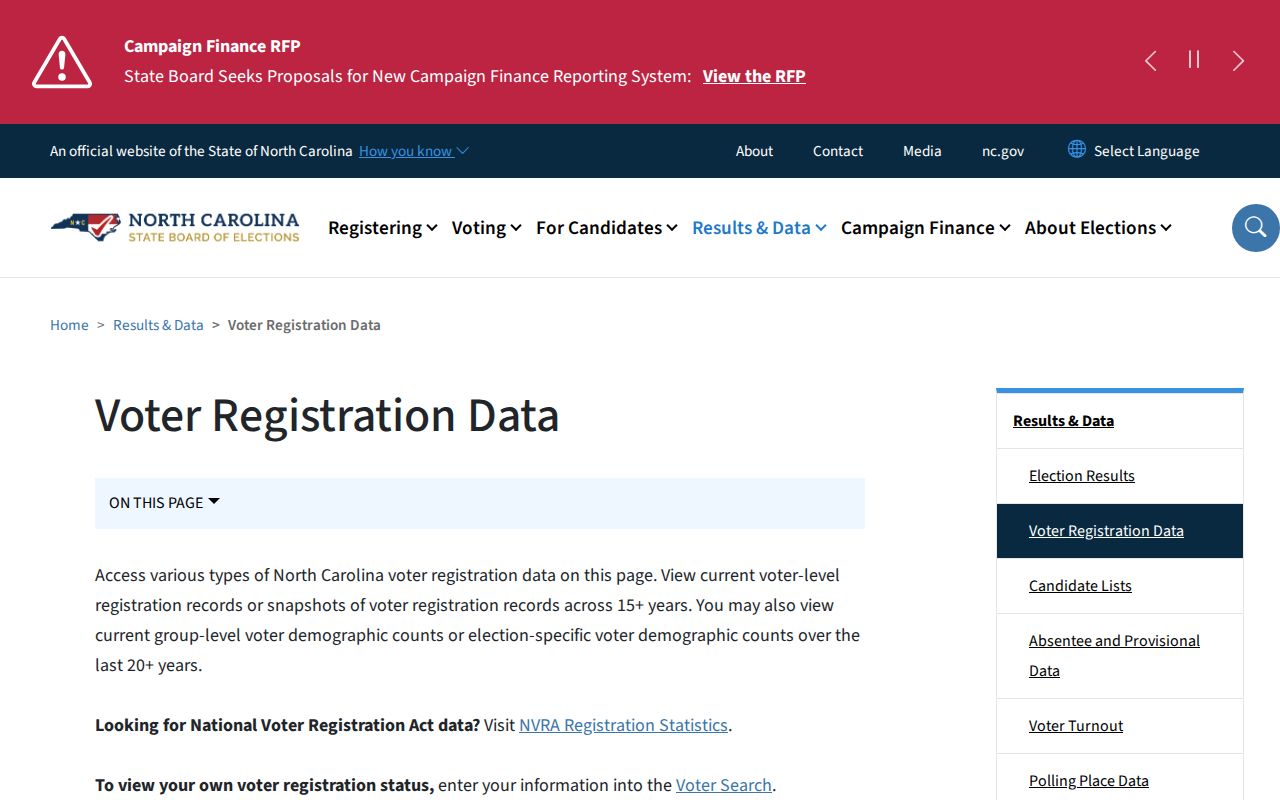
The download page separates current voter data from historical and participation files, so the correct file depends on whether the goal is present status or change over time.
Decode Mecklenburg Bulk Voter Data
The current voter file is broad. It carries county identifiers, NCID, name components, status and reason codes, residence and four mailing-address lines, phone, confidentiality flag, registration date, demographic fields, and many political or service districts. District columns can include precinct, municipality, ward, congressional, Superior Court, judicial, state Senate and House, county commissioner, township, school, fire, water, sewer, sanitation, rescue, prosecutorial, and tabulation districts.
Current registration data does not include the participation history. The separate history file joins by NCID. NCSBE makes individual and historical snapshots reaching more than 15 years available, while aggregate and election data extends beyond 20 years. Treat those as separate series, not one unbroken profile. Registered, formerly registered, denied, and incomplete records may occur in current downloads, which makes the status codes essential before counting people.
Note: The public file reports verification flags, but it does not expose the private identification numbers those flags confirm.
Protect Mecklenburg Voter Addresses
North Carolina’s Address Confidentiality Program serves qualifying survivors of domestic violence, sexual assault, stalking, and trafficking. It provides a substitute Attorney General address and mail forwarding. Enrollment goes through a trained application assistant. The program can be reached at 919-716-6785 or acp@ncdoj.gov, and Chapter 15C governs the program.
Voter-address protection is not automatic. A Mecklenburg County voter presents the Board of Elections with a qualifying protective order or current ACP card and a signed safety statement. While protection remains valid, the actual address is withheld. The person’s name, precinct, and other open registration fields stay public. Law enforcement and a person authorized by court order may inspect the true address under the governing rules.
Reach Mecklenburg Elections Records
The Mecklenburg County Board of Elections is the county channel when the state search or standard file cannot answer a local question. Its office is at 741 Kenilworth Avenue, Suite 202, Charlotte, NC 28204. Mail goes to PO Box 31788, Charlotte, NC 28231, and the phone number is 704-336-2133. The research source did not publish reliable counter hours, so call before an in-person visit.
The county website provides elections contacts, registration information, demographics, statistics, and historical-data routes. For a nonstandard electronic county or precinct list, describe the fields, geography, and date range needed. The county may assess actual preparation cost for custom work. General access-law questions belong with the broader Mecklenburg County public records process, but election-specific data should start with the Board of Elections.
The local routes can be seen on the official Mecklenburg elections source.
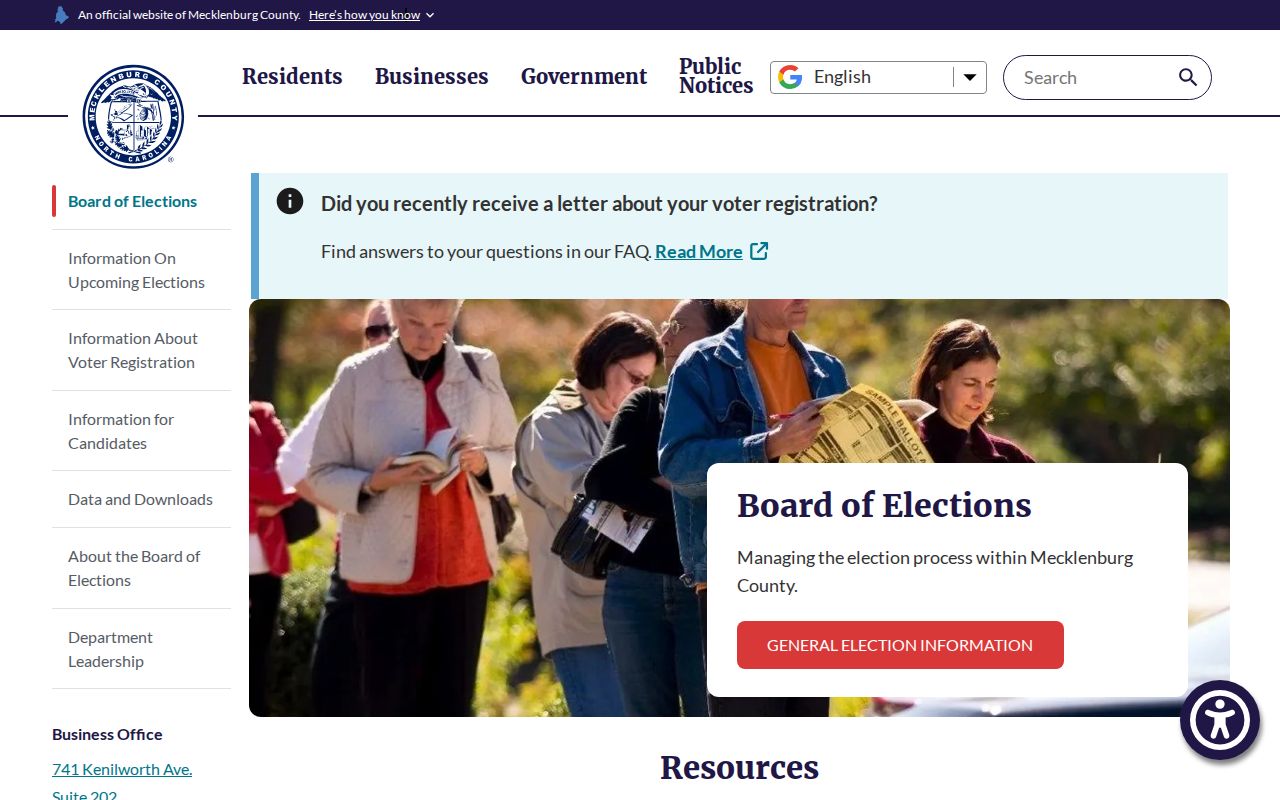
The county page is the practical fallback for staff contact and local election data when the statewide tools do not supply a custom view.
Trace Historical Mecklenburg Voter Rolls
Begin historical work with NCSBE snapshots and participation files, since they offer the clearest documented time series. A current file cannot prove that a much older removed voter was never registered. The ten-year omission rule for some removed entries is one reason to compare past snapshots, status dates, and history joined by NCID.
For records older than the published state data, contact the county elections office, then search the State Archives of North Carolina catalog and the Charlotte Mecklenburg Library’s Robinson-Spangler Carolina Room. The Carolina Room holds county government material, newspapers, city directories, maps, and family-history sources that can place a voter in context. Onsite research is by appointment, while limited copies may be handled through reference service.
No official dated catalog of Mecklenburg County poll books was verified. Ask the archives or library about live catalog holdings instead of assuming that a specific poll-book year survived or is open online.
Use Mecklenburg Voter Records Lawfully
Open election data supports civic transparency, registration checks, family history, and study of change across precincts. It does not erase the legal boundary around confidential fields. Never try to reconstruct masked identity data, copy a signature, expose a protected address, or use the rolls to monitor and harass someone. When a record seems stale, verify status through the official voter lookup or the county office rather than treating a bulk row as final.
A safe research trail keeps the source date, file name, status code, and NCID with each note. It also separates participation from ballot choice, because only the former is public. For historical matches, compare names, county, registration dates, and districts with care. Shared names are common, and a mailing address may not be the same as a residence address.